A three-person support team can comfortably handle a few hundred conversations a day. What breaks them is not volume — it is having those conversations spread across four browser tabs, two phones, and a shared password nobody wants to rotate.
The fix is rarely more people. It is a single queue and a small set of rules everyone actually follows.
The real cost of tab-switching
When LINE OA, Facebook Page inbox, Instagram DMs and email each live in their own window, four things go wrong at once, and none of them show up in a dashboard.
Messages get answered out of order, because whoever opens a tab answers what is on top rather than what has waited longest. Two people reply to the same customer, because neither can see the other is typing. Conversations that arrive at 6pm on a channel nobody has open that evening sit until morning. And nobody can answer “how long are customers waiting?” without guessing.
The last one is what keeps the problem alive. You cannot fix a queue you cannot see.
One queue, sorted by wait time
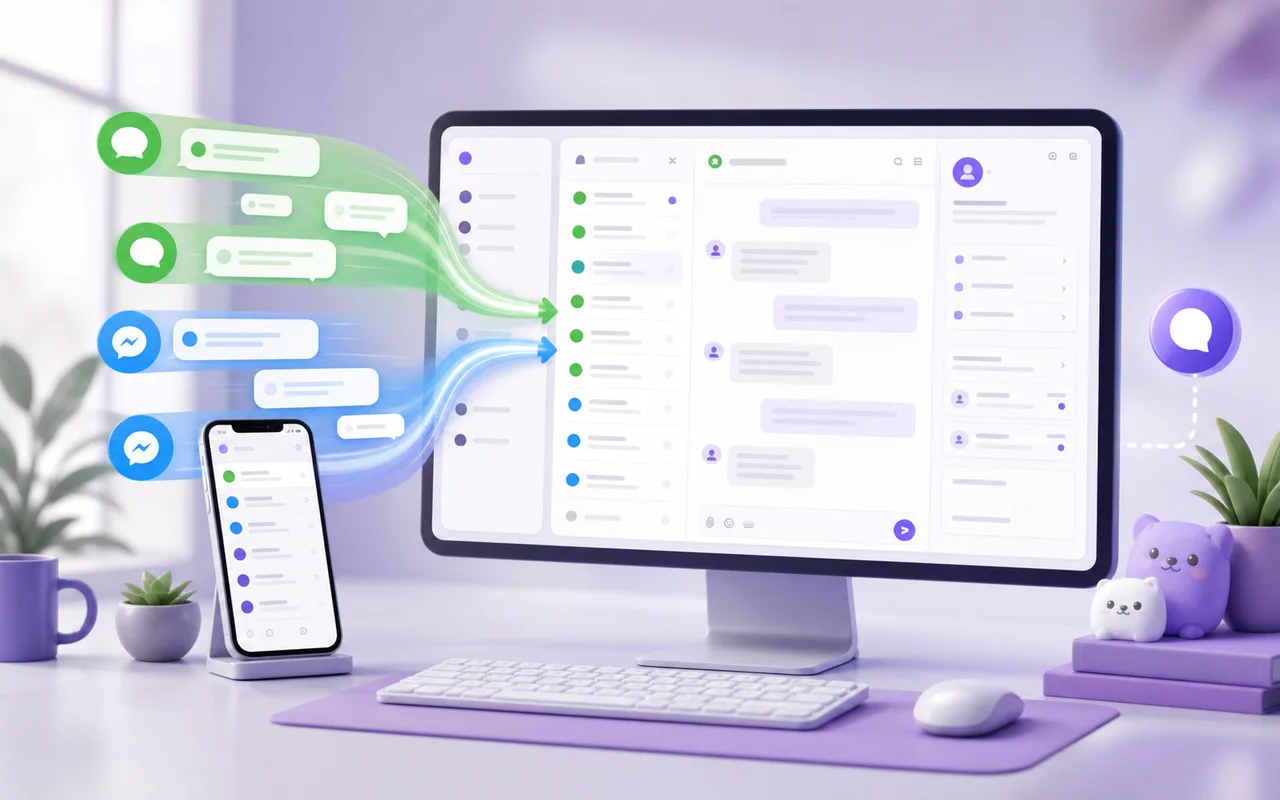
The single highest-leverage change is putting every channel into one list and sorting it by how long the customer has been waiting — not by channel, not by newest first.
This sounds obvious and it is, but it inverts the default behaviour of every native inbox. Native inboxes sort by most recent activity, which systematically buries the customer who wrote once and is patiently waiting in favour of the one who has sent five follow-ups.
Once you have one queue, the channel becomes a detail — useful context on the conversation, not a separate workspace.
Assignment rules that work at three people
Elaborate routing is for teams that have outgrown a shared queue. Below roughly eight agents, three rules cover almost everything:
Assign on first reply. Whoever answers owns it until it closes. No round-robin, no manual claiming step. This alone eliminates most double-replies.
Ownership survives the reply. When the customer writes back two hours later, it returns to the same person, not to the top of the shared pile. Continuity is worth more than perfectly even load.
One explicit unassign path. Going off shift, or genuinely stuck, means dropping it back to the queue with a note. If the only way to hand something over is a message in a group chat, things will be dropped.
Add a fourth rule only when you feel the pain: route by language, or by topic, or by VIP status — but not before.
Channel quirks worth encoding
Unifying the queue does not mean pretending the channels are identical. A few differences matter enough to build rules around.
LINE is effectively a 1:1 conversation with no subject line and a long memory — the same thread can span months. It is also where customers most expect immediacy. Treat a LINE thread as an ongoing relationship, not a ticket, and keep customer context attached to it.
Facebook splits into two very different surfaces. Page DMs behave like LINE. Public comments on posts and ads do not — they are visible to everyone, they attract other customers’ questions, and an unanswered one under a running ad is actively costing you money. Comments deserve their own SLA, usually a tighter one.
Instagram DMs behave like Facebook DMs, with the wrinkle that story replies arrive as messages and are often not questions at all. Filter them or you will train your team to skim.
Email is the only channel where a slower, more complete answer beats a fast one. Do not apply your chat SLA to it.
Set hours, and say them out loud
Small teams lose more goodwill to unmanaged expectations than to slow replies. If you do not answer at 10pm, say so — in the LINE greeting, the Facebook away message, and the chat widget. A customer who knows they will hear back at 9am is a satisfied customer. The same customer, told nothing, is drafting a bad review at 11pm.
Pair this with one honest internal number: median first response time during working hours. Not average — a handful of overnight messages will drag an average into meaninglessness. Median tells you what a typical customer actually experienced.
A daily rhythm that holds
The teams that stay on top of this run something close to the same loop:
- Morning: clear anything that arrived overnight, oldest first, before touching new messages.
- During the day: work the single queue by wait time; assign on first reply.
- Before close: anything that cannot be resolved today gets a holding reply with a real expectation, not silence.
- Weekly: look at the ten longest waits and ask what caused each one. It is almost always the same two or three causes.
That weekly review is where the compounding happens. Most long waits trace back to a missing macro, an unclear ownership boundary, or a question that should have had a documented answer months ago — all fixable in an afternoon, and all invisible unless you look.
What this buys you
None of this requires new headcount or a bigger tool budget. It requires the queue to be one queue, the ownership rule to be unambiguous, and someone to look at the outliers once a week.
Do that, and the next real decision — whether to add automation, and where — gets much easier, because you will finally have a clear picture of where the time actually goes.